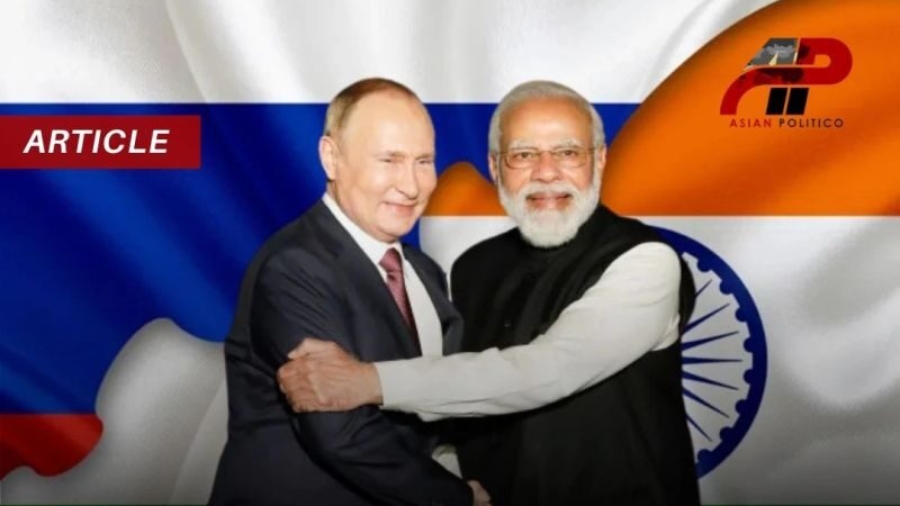
India has performed a delicate balancing act whereby it tries to maintain good relations with Russia as well as satisfy the USA. This balancing act has so far been successful. But the entry of China into the equation makes the situation more complicated. China, which is India’s biggest competitor at this point, also maintains close cooperation with Russia. However, so far, Prime Minister Modi has carefully managed the diplomatic relations with the West. Using the US for its diplomatic leverage in its conflicts with Pakistan alongside extracting economic benefits from Russia.
Bilateral relations between both countries have stood the test of time. Despite the sanctions and limitations imposed by the US over trade with Russia, India has so far stood its ground and continued to increase trade with Russia even after Russia’s war on Ukraine. The foundation for cooperation was set in the 2018 bilateral summit India-Russia Strategic Economic Dialogue (IRSED), which was established to improve cooperation in the field of economic policy development. Russia has also supported India’s pledge to attain the permanent position in the United Nations Security Council (UNSC).
Thus, even though things have been smooth so far, with India trying to be independent by diversifying its arms market, the India-Russia relationship seems to be in jeopardy. India-Russia relations soared in the 1960s when Russia helped to mediate a ceasefire between Pakistan and India in the 1965 war and then fully supported India in the 1971 war militarily and diplomatically. The Soviet Union deployed a flotilla of warships, including nuclear-armed destroyers and submarines, to the region in response to India’s request.
The Soviet Navy’s officers also encircled US and UK warships to stop them from reaching India. It also supported India in the UNSC and accepted its pledge to recognize Bangladesh as an independent country. This strengthened the diplomatic and security relations between India and Russia and led both countries to sign the treaty of friendship, peace, and cooperation to strengthen strategic mutual cooperation between both the states. However, now that Pakistan is forging an economic relationship with Russia, the strong bond of India-Russia friendship is being threatened.
When it comes to economic relations, India is dependent for its arms and cheap oil on Russia. The cheap oil India obtains from Russia is not only used for its local purposes but also for export purposes after refinement. India has been buying up Russia’s cheap oil to the tune of one million barrels per day. In addition to that, India is also the biggest buyer of Russian fertilizers, with India importing 7.74 million tons of Russian fertilizer in April–June. All these factors have allowed Russia to recover from its economic slump and boost its exports once again.
Due to these reasons, India has avoided direct condemnation of the Russian aggression in Ukraine despite immense pressures from the West. Prime Minister Modi has gone far enough to say, “This is not the era of war.” This strategic alignment of both states is also supported by underlying ideological alignment between the two states. For instance, both countries support the formation of a multi-polar world, as both countries have voiced their opinions in the BRICS meeting. Thus, organizations like BRICS and SCO further facilitate the development of relations between Russia and India. When it comes to arms, India’s air force currently possesses 410 Soviet and Russian fighters, comprising a mix of imported and license-built platforms.
The Soviet Union has also contributed to India’s development of steel, oil, coal, gas, etc., including the Bhilai steel plant, which is one of the biggest plants in India. India has reciprocated by making investments in Russian oil through government organizations like Indian Oil Cooperation Limited (IOCL) and Bharat Petro Resources Limited (BPRL). The bilateral trade between India and Russia amounted to 49.36 billion dollars in the financial year 2022-2023. During April 2023 to May 2024, the trade between Russia and India saw a 161.22% increase from the same time last year. Both of these statistics show the year-on-year growth of India and Russia relations, despite the growing uncertainties and the fact that Russia has waged a war on Ukraine.
Another important avenue of cooperation between India and Russia has been in the field of space. Russia provided India assistance in developing its first moon mission. The cooperation began in 1960s and then in 1975, Russia assisted India in sending its first satellite, Aryabhata, into space. Since then, both countries have continued to maintain close cooperation in the field of space. During the 1990s, Russia helped India with its first cryogenic rocket engine technology. A cryogenic engine is used as a rocket engine in rocket vehicles and is known for its highly efficient liquid propellant engine. Currently, India’s highly anticipated Gaganayaan mission is being supported by Russia, whereby 4 Indian pilots are being trained for the first human-created mission to space.
In addition to these existing areas of cooperation, India and Russia can expand their bilateral relations by focusing on other avenues of cooperation, such as people-to-people exchange. India, being the 2nd most populous country in the world, offers a vast opportunity for Russia to gather human labor and acquire skilled and unskilled people for the functioning of their vast economy. Nevertheless, this growing cooperation between Russia and India can disturb the delicate balance of South Asia, whereby India’s cooperation with the US was vital to deter China. If the relationship between India and Russia is strengthened more than the US, it can shake the stability of the whole region.
However, India has increasingly asserted its independence while making its diplomatic decisions, giving a sign to the US that its diplomatic sovereignty might never be compromised. In addition to that, as India is developing its own technology for arms and weapons, it is slowly gaining an upper hand in the relationship considering India’s rapidly booming economy. Moreover, with Russia’s relationship being weakened with the West, it heavily relies on India and China as its arms and oil markets. Thus, both countries can further improve their relations by focusing on soft power and cultural exchange programs to develop familiarity and create deep-rooted and long-lasting relations based on respect for each other’s ideological stand points and cultural differences.

Hamna Imran is an undergraduate student at National Defense University, specializing in defense and security issues of South Asia. She contributes insightful op-ed articles to Global Defense Insight and Stratheia.
Add a Comment