Climate change acting as a threat multiplier has taken the world under its shadow. It has disrupted the balance of the ecosystem. Currently, every country is fighting with this threat. In the light of this danger, every state is developing its climate change policy to develop strategies that can fight against this threat. All provinces and departments are also collaborating and coordinating with one another to produce fruitful results. Pakistan is also following a similar pattern. Pakistan occupies the 5th position among the nations that are badly affected by climate change. Thus, the country adopted a National climate change policy in 2021 to combat climate change.
To facilitate the federal, provinces have also taken the initiative to formulate their independent climate change policies. These policies are inclusive in a sense as they cater to all the sectors that are in turmoil over climate change. These policies also cover various adaptation and mitigation strategies to overcome climate change and reduce GHG emissions. The province of Baluchistan is no exception to this. The province located in the southwestern part of Pakistan is largest in terms of area but is least populated. It developed its first ever climate change policy in June 2024, in accordance with UNDP. Major funding to formulate the policy is done by Germany, Japan, the UK, Sweden, and Spain.
Although the province is rich in minerals and hydrocarbons but lacks connectivity with the artery of Pakistan, i.e., the Indus River, where the economy perishes the most. As a result, the province is backward in economic terms and is not advanced both socially and economically. Thus, poverty dominates in the province. The importance of the province increased after China introduced its Belt and Road Initiative (BRI) program. Under this project, Gwadar port will be of prime importance under the China-Pakistan Economic Corridor (CPEC). The province has underrepresentation in the political realm as well due to the minimum population.
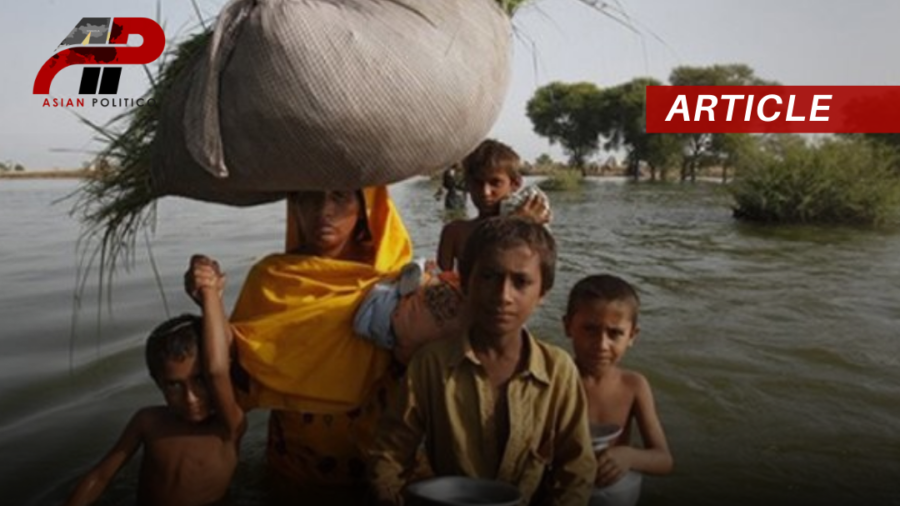
Along with these social, economic, and political vulnerabilities, environmental vulnerability also exists in Baluchistan. Water scarcity prevails along with varied precipitation patterns and increased evaporation, leading to a water crisis. As a result, the agriculture sector faces the most consequences. It is one of the cornerstones of Baluchistan’s economy. Due to extreme events like floods, droughts, and heatwaves, food productivity has decreased both in quality and quantity. Moreover, due to increased coastal erosion, damage to coastal infrastructure and communities also dominates in the province.
Other than these events, forest fires also exist in the area, damaging a large number of trees; for example, in 2022, 40% of trees in the Koh-e-Sulaiman range were damaged due to forest fires. Similarly, in 2017, the highest temperature was recorded in Turbat, i.e., 52 degrees Celsius, marking it as the hottest point in Pakistan. Among the most affected ones are women, children, and disabled persons. Their health is at risk. Thus, to adapt to these threats, proper resilience and adaptation strategies are required. Along with these mitigation strategies are also needed to reduce greenhouse gas emissions. Baluchistan Climate Change Policy (BCCP) covers all these aspects.
BCCP ensures commitment of the Government of Baluchistan (GoB) towards promoting adaptation and resilience building, mitigating GHG emissions, natural resource management, waste management, biodiversity conservation, climate change funding, green economy, international collaboration along with private sector engagement, gender equality, social inclusivity, capacity building (climate education), monitoring, and reporting. It pays a particular focus on SDG 13: Climate Action. The policy is aligned with national and international climate goals. Among the national goals are NCCP, 2021; NAP, 2023; and international long-term vision entitled in Article 4 of the Paris Agreement, 2015; UNFCCC and other agreements ratified by Pakistan.
Agriculture and livestock are priority sectors of the policy. Plantation of climate-resilient seeds and water-efficient irrigation practices are a prime focus. Ecosystem-based approaches are suggested, such as mangroves and forest building. A primary focus on conservation of biodiversity is also present. The policy also aims to protect the coastline of Baluchistan, which is 735 km in length. Steps will be taken to minimize sea level rise, ocean acidification, erosion, and storm surges. A strict check and balance on resource extraction and illegal fishing will be observed in order to protect marine life and the blue economy. Renewable energy sources are promoted in transportation and industrial sectors like mining to reduce the dependence on fossil fuels, which are the major contributors to greenhouse gases.
Use of solar energy as the main source of renewable energy to produce electricity is suggested. Public transports such as the Green Bus Service, low-carbon marine vessels, and others should be adopted. Proper cost of climate actions will be estimated and included in the annual budget framework. Performance evaluation charts will also be developed. In this manner, accountability will also be ensured. Concerning the reduction of GHGs, policy highlights the financial constraints the province is facing. Along with financial constraints, gaps in technology faced by the province are also made part of the BCCP. The policy gives importance to the role of academicians in research on energy-efficient and cleaner production and reclamation techniques.
To keep an eye on the implementation work, the policy also gives suggestions in this regard. Creation of specialized institutions is under plan for practical application of policy. Exclusive BCCP Cell will be developed, coordinating the activities on climate change and environmental sustainability. In addition to this, the Baluchistan Climate Change Coordination Committee (B4C) is created for effective implementation of policy. The main task of B4C is to keep check and balance on activities of BCCP Cell and Climate Change Fund (CCF) and coordinate their activities. B4C will conduct impact assessments and will give up-to-date information so that immediate decisions regarding which sector needs more attention can be taken.
The BCCP highly emphasizes the role of government and policymakers in implementing the strategies. Coordination between multistakeholders is discussed, including NGOs, government departments, public sector institutions, private sectors, academic sectors, etc. Quarterly and annual reports will be generated to check the progress. Various performance indicators, such as GHG emission reduction, climate-resilient infrastructure, local community engagement, agriculture adoption (drought-resistant crops), and efficient irrigation systems, whether installed or not, will be installed. A diverse range of indicators encompassing all sectors from individual to government level is made part of the policy paper. Government officials will also get training regarding climate change and the strategies of BCCP. Thus, a bottom-up approach is followed.
The role of youth is also emphasized, as the province comprises a 20% youth population. The policy paper promotes many youth-led initiatives such as climate clubs, educational programs, and others. These programs will develop their skills. It aims to promote their startups, which encompass climate resilience and mitigation strategies. Inclusion of youth in decision-making bodies is emphasized. The policy also aims to promote jobs for everyone, including youth, women, children, and transgender people, eradicating poverty from the province. The government is aware that women, children, and disabled persons are more exposed to climate vulnerability. Thus, the green program will promote social and economic opportunity for these women and girls, particularly. This will also ensure their health, pregnancy ratio, exposure to heatwaves, and infectious diseases.
The second section of policy is particularly devoted to the action plan. Climate-resilient agriculture is promoted in agroecological zones along with groundwater conservation and rainwater harvesting. ICT-based pest surveillance system installation is suggested. Climate-compatible technologies in the fisheries sector, like fish cage culture, are also part. Insurance of sustainable fishing and counter illegal fishing such as trawling is also discussed. Moreover, eco-labelling and eco-packaging are promoted, especially of apples, apricots, grapes, and others. promote Biodiversity conservation plans to conserve forests, rangelands, and marine environments are emphasized. Nature-based solutions are promoted for resilient strategies. BCCP says that legal capacities should be enhanced by Baluchistan’s Forests and Wildlife Department.
To conserve water, regulation of groundwater extraction is required. The idea of installation of recharging aquifers such as rainwater harvesting, groundwater recharge wells, etc. should be promoted. This will restore water balance in the province. Construction of dams to store water is a top priority of policy. Concerns for adequate urban planning and development are also discussed. Climate-resilient urban infrastructure along with proper health camps should be established. The government should ensure the presence of vaccines, medicines, doctors, and nursing staff in hospitals and camps. Proper district disaster management committees should be formed to calculate the upcoming disasters and thus a timely response can be generated.
The third section is devoted to the financing strategy, which will be adopted by Baluchistan’s government to make BCCP a reality. About 116 billion rupees are allotted from the development budget for adaptation and mitigation actions. In addition to this, international and domestic financing, public-private partnerships, and assistance from the Green Climate Fund developed under UNFCCC will play a key role. Pakistan has signed MoUs with different countries for climate resilience and adaptation. Thus, the center should give the due share of the province so that action can be taken. Baluchistan should sign blue bonds under which the province’s mitigation and adaptation objectives regarding mangrove forests will be promoted.
By reading the policy paper in detail, it is found that no discussion on wind energy and geothermal is done, i.e., how it will contribute to production as a source of renewable energy. A positive impact of CPEC is given by increasing the trust of people in Baluchistan that this project will bring prosperity for the province. Along with other sectors, waste management is also discussed. A discussion on 3Rs, particularly on reusability of products, is done. Construction of parks, green roofs, and green construction codes is suggested, which is a positive sign that policy is made in the right direction.
Proper division of projects is done under short-term (1-3 years), medium-term (4-6 years), and long-term (7-10 years) programs. BCCP ensuring transparency by devising ways of proper communication with the public is another positive aspect of the policy gaining the trust of people in government. Overall, the BCCP is a good addition to the NCCP, 2021, giving a detailed picture of the present situation of Baluchistan and what measures it aims to take to improve its condition. If followed accordingly, then Baluchistan’s future regarding its socio-economic conditions of people along with its environmental aspect will be improved.

The author is Yusra Sarwar. She is currently enrolled in the M.Phil. program in International Relations at National Defence University. Her areas of interest include the foreign policy of great powers, especially China, maritime security, sports, and climate change. The regions she is interested in looking into are the South Asian region and the Indo-Pacific region.
Add a Comment