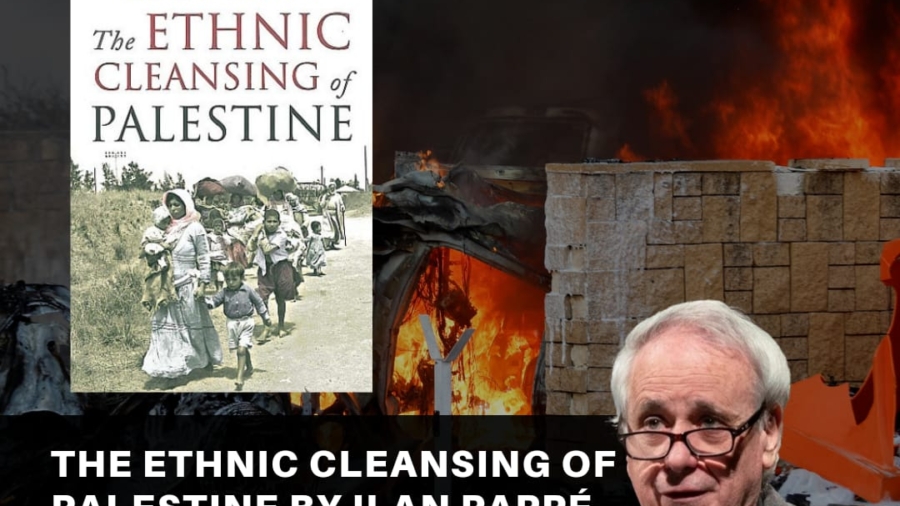
“The Ethnic Cleansing of Palestine” by Ilan Pappe is a meticulously researched and highly controversial historical account that examines the events surrounding the establishment of the state of Israel in 1948. Ilan Pappe, an Israeli historian renowned for his critical approach to mainstream Zionist narratives, argues compellingly that the creation of Israel involved the deliberate and systematic expulsion of the Palestinian Arab population, which he categorizes as ethnic cleansing.
The book begins by scrutinizing the planning phase before 1948. Pappe introduces the reader to Plan Dalet, a strategic blueprint designed to ensure the removal of Palestinians from their lands. He asserts that this plan aimed at the destruction of both rural and urban areas to enable the Zionist movement to secure a Jewish majority in the future state. “The aim of the plan,” Pappe writes, “was in fact the destruction of both the rural and urban areas of Palestine to enable the Zionist movement to secure a Jewish majority in the future state.” According to Pappe, this was not merely a military strategy but a calculated effort to alter the demographic makeup of the region.
As the narrative progresses, Pappe provides harrowing details of the execution of this plan, documenting numerous massacres, forced expulsions, and the systematic destruction of Palestinian villages. One of the most disturbing events detailed in the book is the massacre at Deir Yassin, where over 100 Palestinian men, women, and children were killed by Zionist paramilitary groups. A survivor recalls, “They lined us up, shot us, and left us to die. The screams of women and children filled the air, but there was no mercy.” This massacre, Pappe argues, was part of a broader strategy to instill fear and prompt mass exodus.
Pappe also situates these events within a broader international context, examining the reactions of the British mandate authorities, the United Nations, and neighboring Arab states. He highlights how international indifference and geopolitical considerations allowed the Zionist leadership to proceed with their plans. “The world watched,” Pappe notes, “but did little to intervene as entire communities were uprooted and their homes obliterated.”
The consequences for the Palestinian people are a central focus of the book. Pappe explores the creation of the Palestinian refugee crisis, a direct result of the mass expulsions and destruction of villages. He poignantly describes the plight of the displaced Palestinians, who found themselves stateless and scattered across neighboring countries. One refugee recalls, “We walked for days, leaving behind our homes, our lands, and our lives. There was nothing but despair ahead of us.”
Pappe’s work represents a significant contribution to the field of revisionist history. He challenges dominant historical narratives that portray the displacement of Palestinians as a byproduct of war rather than a deliberate act of ethnic cleansing. This revisionist approach has sparked considerable debate and controversy. Pro-Israel scholars and commentators criticize Pappe, arguing that his interpretation is overly simplistic and politically motivated. They contend that the events of 1948 were complex and multifaceted, involving numerous factors and actors.
Despite the controversy, Pappe’s book is widely praised for its thorough research and detailed documentation. His extensive use of primary sources, including archival documents and personal testimonies, provides a robust foundation for his arguments. By presenting these materials, Pappe encourages readers to critically engage with established historical narratives and consider alternative perspectives.
One of the strengths of Pappe’s work is his ability to humanize the tragedy. By including personal stories and testimonies, he brings the experiences of Palestinians to the forefront, allowing readers to grasp the human cost of the events of 1948. These personal accounts, interwoven with historical analysis, create a powerful and emotive narrative.
However, some critics argue that Pappe’s perspective may be influenced by his political views, potentially affecting the objectivity of his analysis. They caution that while his work provides valuable insights, readers should consider it within the context of the broader historical debate.
In conclusion, “The Ethnic Cleansing of Palestine” is a thought-provoking and challenging work that provides a critical perspective on one of the most contentious periods in Middle Eastern history. Ilan Pappe’s meticulous research and bold assertions make this book an essential read for anyone seeking to understand the historical roots of the Israeli-Palestinian conflict. Whether one agrees with his conclusions or not, Pappe’s work significantly contributes to the ongoing discourse, demanding a reevaluation of accepted historical truths and a deeper understanding of the past’s impact on the present. As Pappe himself concludes: “Acknowledging these events is crucial for any future reconciliation and peace.”

Ramsha Waheed holds a Master's Degree in English literature. Her areas of interest include history and research, particularly in the Indo-Pak region.
Add a Comment