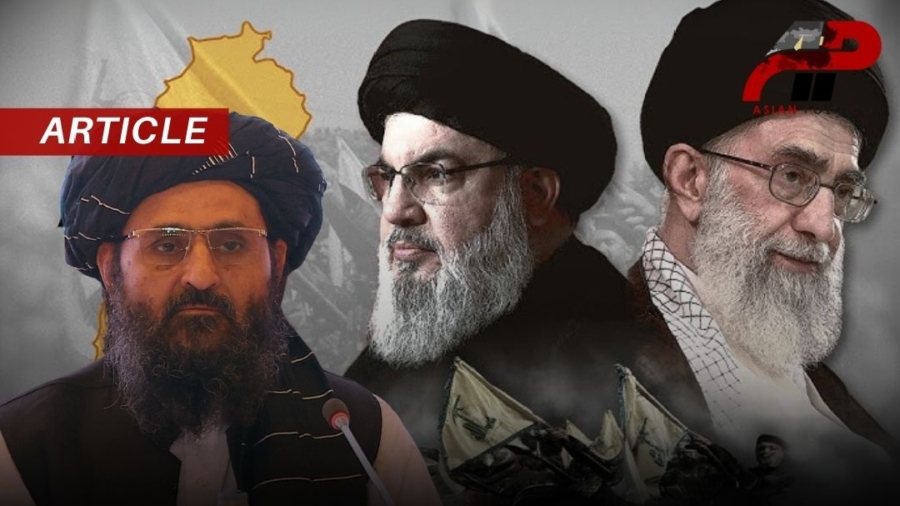
There are 195 UN recognized states, and their political systems are categorized from democracy, monarchy, oligarchy, dictatorship, aristocracy. Among all these systems democracy is more widely administered. Amidst of 57 Muslim countries there are only some that have properly opted Islamic law, while others have hybrid systems or secular systems. While Iran and Afghanistan, the two neighbouring states sharing history and culture, both have designed their political systems on the basis of Islamic law. The difference is Iran processes on Shiite orthodox and therefore Afghanistan on Sunni orthodox.
Political systems of Iran and Afghanistan are theocratic, but their systems are far distinct from each other. The government system of Iran is a blend of Islamic and Republican, while Afghanistan’s government system is Authoritarian. Iran became the Islamic republic of Iran (Jomhori-e Islami-e Irân) after the revolution of 1979, the written constitution was also adapted the same year which was based on Islamic laws(Shariah). Its constitution was once amended in 1989.
The national language of Iran is Persian, with 60 percent Persian ethnicity with Islam as the major religion. Supreme leader (Velayat-e Faqih also written Wali Faqih) is the head of state with the highest authority. He is responsible for important appointments like head of Assembly of experts, judiciary, and members of Guardian council. He is the head of the military, besides that he also has the authority to declare war. Ali Husseini Khamenie has been the supreme leader of Iran since 1989. After the Supreme leader the highest authority is in the hands of the president which is the head of government. Supreme leader has the authority to take back powers of the president and parliament also plays a crucial role in it, if he violates any law or goes against Shariah. Iran has a unicameral legislative structure. It has only one house which is called Majlis(parliament); it contains 290members who are selected for four years through general elections. Its duties include ratifying treaties, approving budgets and passing laws. Other than parliament there are other two bodies which influence the legislation, they are Council of Guardians and Expediency Discernment Council.
Council of Guardians contains 12 members, where six are elected by the Supreme leader while other six are elected by parliament for six years. Its duties include assessment of the qualification of candidates which are going for presidential election, while it is also responsible for passing laws. A law cannot be included in the constitution until it is passed by the Guardian Council. Expediency Discernment Council resolves conflicts between Council of Guardian and Parliament. It includes the senior officials. Other than this there is another important body in Iran’s political system it is Assembly of Experts, which contains 86 members and these are also elected by common people. It is responsible to elect the supreme leader from one of its members. It also contains an authority to depose the Supreme leader from its authority if he violates any law or constitution.
The thirty one provinces of Iran are governed by governors which are appointed by the interior minister of Iran. Iran uses Islamic law for its judicial system, and its head is chosen by the Supreme leader. According to Iran’s constitution a person above 18 years is eligible to vote. Islamic Revolutionary Guard Corps(IRGC) is the supreme armed force of Iran. It protects Iran from external attacks.
Afghanistan was a republic before the arrival of Taliban’s in 2021. In Islamic Emirate of Afghanistan Amir is considered the highest authority. Hibatullah Akhundzada is the current supreme leader of Afghanistan. All important decisions whether they are political, judicial or military related are taken with the decree of Amir. He is the head of state of government and state, but prime minister is responsible for day to day activities and handles the executive branch of the system. The powers of the Supreme leader and prime minister are absolute and as Afghanistan is currently lacking in a proper written constitution, so the only possibility of their power exemption is either internal conflicts or external intervention or might be their death. The executive branch of Afghanistan consists of the Council of Ministers which contains 33 members according to 2021 reports.These members are mainly senior Taliban leaders and officials of their old government(1996-2001). Afghanistan’s key governmental institutes include the Ministry of Interior which look into the interior matters of Afghanistan. Other than this are the ministry of Justice, ministry of defence, Ministry of education and Ministry of foreign affairs. Other than this Afghanistan has a Leadership council also called Rahbari Shura it guides the Supreme leader in taking importantdecisions.
The judicial system of Afghanistan is totally Shariah based. Afghanistan has no proper written constitution unlike Iran. The only documentation is written by Abdul Hakin Haqqani which is named as “Islamic Emirate Shariah law”. The punishments are given on the basis of Shariah.It includes Shariah courts, besides that Afghanistan has a Jirgah system for judicial purposes. Like Iran Afghanistan is also divided into provinces that are governed by governors.
Unlike Iran Afghanistan does not have a proper political system, it is because Afghanistan was in a state of war for almost two decades. The other reason is that before Taliban Afghanistan was surviving on external aids, which were stopped as Taliban took control, they had to rely on internal resources. Despite so many issues, the Taliban made Afghanistan a much more peaceful place, they are investing in education, infrastructure, they are working against drugs(mainly opium) and eliminated it at high instinct. They are working to reduce corruption in their country. On the other hand Iran contains a strong national sovereignty. Iran is working on health, infrastructure and education. In the Middle East Iran has the most advanced health system.
Muslims have an extravagant ruling history on the basis of Sharia law, and during those golden periods the crime rate, poverty rate were so low. There was the same rule for everyone despite their social status. Women used to enjoy a full sense of security, property rights, education rights and marriage related rights, they were not oppressed. Hazrat Umar(R.A) was the one who introduced the departments of police, intelligence( to gather information related to any threats). He also introduced a proper administrative system. Baghdad was the hub of education under Muslim regimes. Today a good example of any state where Shariah law is being practiced is Saudi Arabia , the crime rate is so low there, because punishments are based on Islamic teachings. It is a concept that Islamic punishments are cruel, but due to severity of these punishments people restrains themselves from doing bad. If Muslims again go back to the ruling system on the basis of Islamic system they will gain back their lost supremacy.
Iran and Afghanistan are doing their best to run their systems on the basis of Islamic law. There is a common conspiracy in western world that Muslim women are being oppressed in Iran and Afghanistan, but things are different in real women are enjoying their rights but within the limits of islam. Iran opted a republic system with theocracy rule, unlike Saudi Arabia which has monarchy, due to this system common people are directly involved in the political system, whereasAfghanistan’s political system has a leadership council, which contain Ulamas (religious leaders), military leaders, which is similar to the electoral college during the reign of Caliphate Rashidun, which some see as a more Islamic system. Taliban have got control of security aspect but if the social justice through better governance is ensured then Shariah system may spread in other Muslim countries as well.

She is research Assistant with Vision Pakistan 2050. Her background is of politic science. Her areas of research include comparative politics, political philosophy and power struggle within different political system as well as effectiveness of different governance models.
Add a Comment