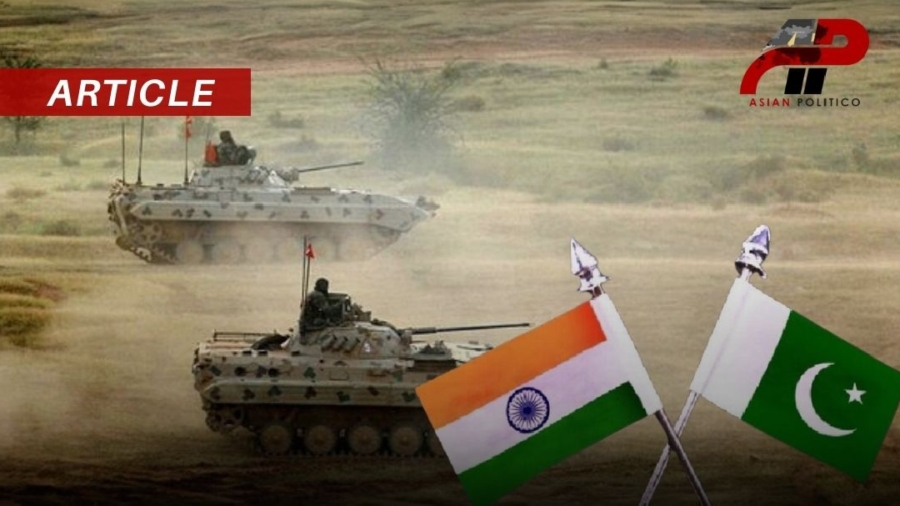
Military Doctrine is one of the essential elements of armed forces, it directs military that how should they fight, when to fight and what kind of modus-operandi (method of operation) to us for carrying out objectives in expected way. Indian military doctrinal objectives are to elevate
their capability to prevent Pakistan from challenging Indian dominant position. To deter Pakistan from taking offensive actions against India. To wage two front war against China and Pakistan
by establishing security equation with regard to China and preventing any challenge from China. To encircle Pakistan from eastern and western front causing rebellion to next breakup of Pakistan. To increase immense presence in Indian Ocean after China-Pakistan Economic Corridor (CPEC). Last but not least, to achieve status of regional power.
Indian experience of 1962 Sino-Indian war, 1965 and the 1971 Indo-Pak war have made India realized that there is need of proactive and offensive military posture to deter any aggression from Pakistan’s side. And then in 1981 India announced its Sunderji Doctrine named after General Krishnaswamy Sunderji who was the Chief of the Army Staff (COAS) of Indian army at that time. Sunderji Doctrine was based on defensive-offensive strategy, which involves the deployment of seven “holding corps” near Pakistan’s border made up of infantry divisions, mobile mechanized divisions and armored units, while three “strike corps” in Central India made up of mechanized infantry and extensive artillery support. The objective of Sunderji Doctrine was that after absorption of attack by seven holding corps, three strike corps will counterattack and penetrate into Pakistani territory. Whereas, mobilization time was 72-96 hours after pre-emptive strike. But it only remained till 2001 Pakistan-India Standoff.
In 2001, Indian Parliament was targeted by Lashkar-e-Taiba (LET) claimed by India. Which led to the Pakistan-India Standoff 2001-2002 also known as Operation Parakram. It was at this time that Indian Sunderji Doctrine failed, because Indian military took almost a month for deployment across India-Pakistan border. Due to slow mobilization, Pakistan’s military in swift manner deployed its military across border in such a short time, moreover International community intervened to refrain India from taking any offensive actions against Pakistan. This event led to the formation of Cold Start Doctrine(CSD) which was unveiled in 2004.
Cold Start Doctrine was unveiled in 2004, which states that; In case of any Pakistan sponsored terrorist attack on Indian soil, Eight Integrated Battle Groups (IBGs) will penetrate inside Pakistan’s territory within the limit of 50-80 Kilometers to capture eight different locations, while remaining below the nuclear threshold of Pakistan. The mobilization time will be 48-72
hours and all of these objectives will be achieved before International community intervenes.
The main purpose of introducing Cold Start Doctrine was to fill the gaps exposed by the Operation Parakram. Following are the objectives of Cold Start Doctrine:
Quick mobilization of troops within 48-72 hours.
Keep war within the limits by not crossing the nuclear threshold.
Obtain and Capture of Pakistan’s territory.
Achieving all of the above objectives before international community intervenes.
Limited War
Whereas the objectives of Cold Start Doctrine revolves around:
Captured territories will be used as bargaining chip by India.
To punish Pakistan for its support of cross-border terrorism.
Resolution of issues as per India wish.
Actually, the idea of cold start doctrine is taken from Guderian’s Blitzkrieg. His concept of panzer division was incorporated in the form Integrated Battle Group (IBGs) which will contain
8,000-10,000 Troops. Whereas, the close coordination of panzer division with luftwaffe and artillery resonates with the synergistic approach taken by Indian armed forces (Land, Air & Navy). It is not an invention of Indian geniuses but a brainchild of German Blitzkrieg. The basic difference is that CSD is on the strategic level, whereas Blitzkrieg was on tactical and operational level.
As CSD is Pakistan centric, Pakistan responded with the completion of its nuclear triad with the attainment of Agosta-90B submarine (PNS Hamza) along with the testing of Submarine launched cruise missile (SLCM) Babar-III with range of 450km, equipping Pakistan with second strike capability. Pakistan adopted its Full Spectrum Deterrence policy proposed by National Command Authority (NCA) in 2013 to counter CSD. Furthermore, Pakistan also conducted military exercise of Azm-e-Nau in response of Cold Start Doctrine. And the major development by Pakistan on countering Cold Start Doctrine was the development and testing of low-yield Tactical nuclear weapons.
Pakistan in April 2011 successfully conducted the test of Short Ranged Ballistic Missile (SRBM) Nasr (Hatf-IX) as quick response nuclear delivery system. It is a solid-fueled and surface-to-surface missile with the range of 60-70km. Nasr missile has the ability to maneuver during the flight. Lt. Gen® Khalid Kidwai stated: Tactical Nuclear Weapons (TNW) have poured cold water on cold start doctrine. In case of initiation of Cold Start Doctrine or breaching of Kidwai’s redlines (territory, population and industrial hub), Pakistan will use its TNWs against IBGs in its own territory and Pakistan is not going to hesitate because it has First Use policy and Full Spectrum Deterrence policy (dealing with threats at strategic, operational and tactical level by use of nuclear weapons).
In short Pakistan’s Tactical nuclear weapons have poured cold water on cold start doctrine. As they have proved an effective deterrent against CSD. It was made to fill the gaps caused by
Sunderji Doctrine, and yet many military generals raises questions on its very existence. India’s plan to penetrate into Pakistan while remaining below the nuclear threshold is effectively
countered by the accumulation of Nasr.

The author, is currently pursuing bachelors in Strategic and Nuclear Studies from National Defense University Islamabad. His areas of interest are Geopolitics, Nuclear doctrines and Modern Warfare.
Add a Comment