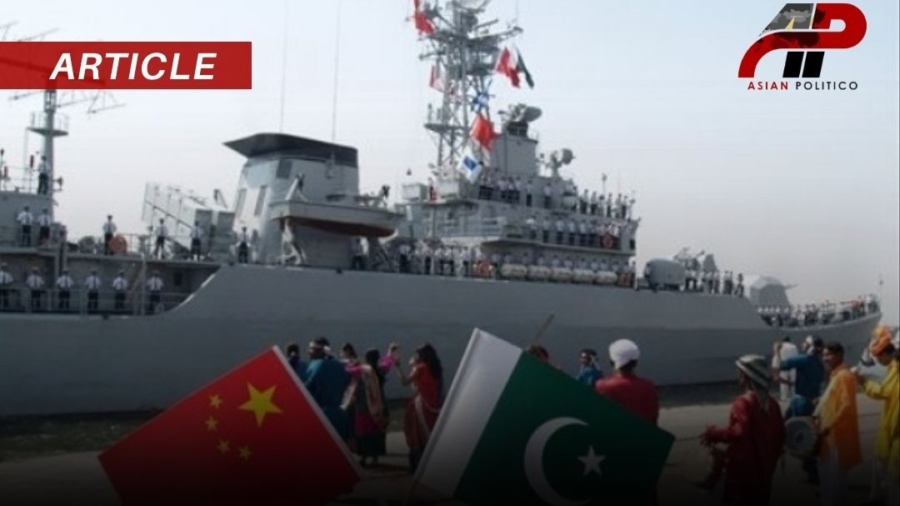
With strategic maritime region in the Indian Ocean, Indian Ocean is home to critical Sea Lanes of Communication (SLOCs) like Strait of Hormuz, Bab el-Mandeb and Malacca Strait. Without these waterways, massive portions of oil would have to be transported longer distances by land and international trade would be drastically affected. As the competition between the great powers, and maritime threat, has risen, the importance of security of these routes as a means to support global stability and protection of national interests as well as opening to uninterrupted trade, has become increasingly important. While securing these waterways is important for their own economic stability, for a country like Pakistan and China, the importance of these waterways is tremendous for exercising regional influence and for maintaining deterrence.
Pakistan and China have a great dependence on secure maritime routes to their trade. The multi-billion-dollar infrastructure project known as the China Pakistan Economic Corridor (CPEC) links China’s landlocked Xinjiang region with strategic Gwadar port of Pakistan. The primary goal of this project is to lessen China’s dependency on the susceptible sea routes—particularly Malacca Strait—and give another maritime course through the Arabian Sea. Accordingly, both countries are concerned with security aspects of Gwadar Port and maritime routes leading to it. Needing to protect these crucial trade routes, India must possess a forceful naval presence in the Indian Ocean and the military power of advanced defense.
Concerning this, China has initiated large military assistance to Pakistan’s naval capability. This provision includes modern warships, submarines and surveillance systems that have improved Pakistan’s maritime strength. Secondly, induction of advanced Type 054A/P Frigates and Hangor-class Submarines not only made Pakistan’s maritime deterrence stronger but also augmented its power projection. However, it is important to note that Pakistan and China’s collaboration with each other goes beyond military support, since both countries are currently working together in anti-piracy operations, combating maritime terrorism as well as disaster response services, in order to achieve the agenda of regional stability.
Often perceived as a counterbalance to India’s increasing naval presence in the region, the Pakistan-China naval partnership has a very broad strategic purpose. Regional economic and security integration, which it is promoting, is crucial. The development of Gwadar Port under the CPEC framework is not just a strategic desire for both nations but conjointly an economic hub linking Central Asia, the center East and Africa. With their security of maritime interests, both countries can develop the region’s trade and investment, thereby contributing to overall economic development.
In addition, the maritime partnership between Pakistan and China is in line with China’s Belt and Road Initiative (BRI) to build a network of strategic ports across the region. While the term, the so called ‘String of Pearls’ strategy plans an inter linked system of Chinese funded ports that will help China to access the global market more efficiently and boost China’s geopolitical clout. This vision is also supported by both countries’ collaboration on maritime security, where both parties work to secure the vital sea routes of the littoral, as well as energy routes, and the pipeline as well as other important projects such as Gwadar.
The nations have also broadened their involvement with regional actors through multiple forums. As members of the Indian Ocean Naval Symposium (IONS) and the Shanghai Cooperation Organization (SCO), their participation in such initiatives shows their support for cooperative security in the Indian Ocean. It also demonstrates the importance of this critical region for China – on imports of Middle Eastern oil – which only adds to the need for coordinated naval presence. Safety of passage through such vital maritime corridors as the Strait of Hormuz is crucial to maintaining stability in global energy markets. So, in terms of relationship with major Middle Eastern states (besides Saudi Arabia and UAE and Oman), Pakistan and China have upheld their relationship through joint naval maneuvers and enhancing security. Through this cooperation, maritime security in Gulf will be secured by combating similar maritime threats such as piracy, smuggling and potential maritime conflicts. Moreover, the two nations have enlarged their maritime security investment which also encompasses the African coastal states as they join forces to fight against piracy and illegal fishing while also safeguarding the important shipping lanes.
The Chinese aid also helped in Pakistan’s naval modernisation which played a crucial role in balancing western powers naval presence in the Indian Ocean, in the U.S., India, France, UK. As the size of these naval forces increases in the region, along with Pakistan’s own increased naval capabilities, this strengthens Pakistan’s naval capability to become a strategic counterweight in providing adequate protection to Pakistan’s maritime interests, which are of vital importance to protect Chinese trade routes, a strategic paradigm towards integration of economic and security framework in economic history. Different from the previous partnerships based on military preparedness, this partnership is to increase the regional stability by addressing the nontraditional maritime threats, boosting economic growth, and improving the diplomatic relationship with other regions and global stakeholders. Joint military exercises, creation of joint security frameworks and the development of a strategic infrastructure such as Gwadar Port are encompassing steps towards addressing the complexities of modern maritime security between both nations. The maritime cooperation that is growing between Pakistan and China demonstrates the necessity of having regional security and stability in the Indian Ocean. The opening of the Straits of Malacca and South China Sea to international trade means that vessels in those straits are effectively an extension of their opening and strengthening its naval capability and increasing cooperation on security initiatives as well as investment in strategic infrastructure plays into the hands of both countries and benefits of regional stability, as it allows them to protect their trade interests. Such a situation overcame the traditional rivalries of the two powers for the common economic and security goals and reflects upon how shared effort is the requisite in doing business with the future’s typical maritime geopolitics. The building Pakistan China cooperation on naval engagement is an example of how strategic alliance can influence the future of regional and global stability, as it will add on to a shifting power dynamic and an ever-increasing competition for maritime influence in the region.

The author, is currently pursuing a bachelor's degree in International Relations at Air University, Islamabad. Her areas of interest include Afghanistan, international security, politics, history and current affairs.
Add a Comment