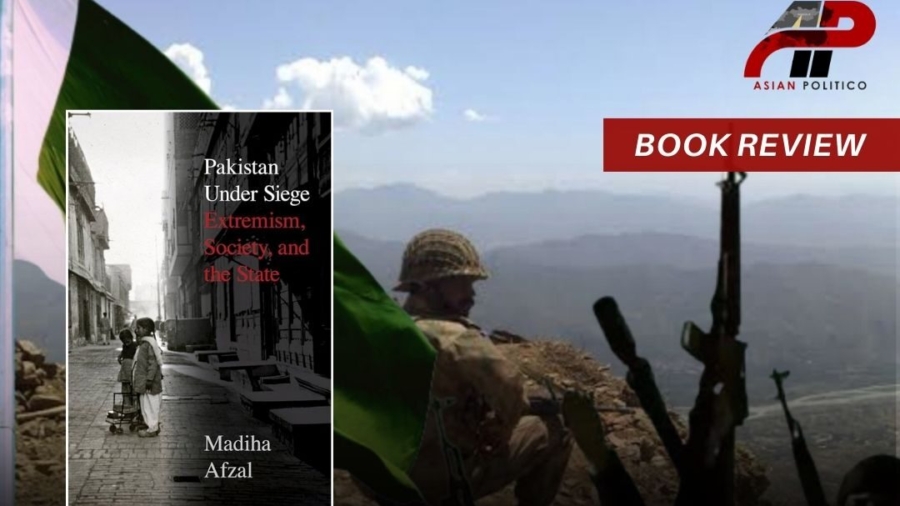
Extremism is a menace that has wreaked havoc upon the world, especially Pakistan. It thrives on the illusion of moral righteousness, sweeping away the delicate tapestry of compassion and empathy that binds us together. Like a venomous serpent, it injects fear and hatred into the veins of societies. “Pakistan Under Siege” is an interesting book written by Madiha Afzal who is a renowned policy analyst and well-read lady on South Asian affairs. She inquired into the origins of extremism and its implications for Pakistan. She is an assistant professor at the University of Maryland’s School of Public Policy and a non-resident fellow at the Brooking s Institution. Her studies examine the roots of extremism in Pakistan and the links between education and radicalisation in Pakistan. She was named to Lo Spazio della Politica’s list of Top 100 Global Thinkers of 2013.
In Pakistan Under Siege, Madiha investigated the issue of extremism in Pakistan. She looked into various factors that played an important role in fostering extremism and militancy in Pakistan. She shed light on the interplay of Pakistan’s history, education system and political milieu in fuelling the issue. Keeping her understanding of the region’s politics, she provided a stupendous analysis of the challenges that Pakistan is facing in its fight against extremism.
In this book, the author looked into how extremism has developed in Pakistan over time. The book begins by looking at Pakistan’s history and how the country has used religion to define itself in opposition to India. In 1980s, policies were put in place to promote Islam as part of national identity under the leadership of Zia-ul-Haq. These policies helped in creating an environment where militant groups could thrive which was important as Pakistan and the U.S. was supporting Mujahideen during the Soviet-Afghan War.
As the story unfolds, she examines the repercussions of these policies in the post-9/11 world. She points out the confusion in Pakistan’s approach to extremism. While fighting terrorism, the government is still in contact with some militant groups. The rise in militancy and terrorism shows the growing challenge Pakistan faces. Unless, the government bring about structural changes in education system and governance to address the root cause of extremism, the situation will exacerbate.
The author did not shy away from criticising Pakistani political leader. She pointed out that the inconsistent policies of leaders towards militant group exacerbated the problem. She gave the case study of Pervez Musharraf as, on the one hand, he was promoting Pakistan as key ally in the global “War on Terror” while allowing certain anti-India militant groups to continue operating on the other hand. This so-called double game harmed the state’s credibility at home and abroad.
One of the most compelling aspects of “Pakistan Under Siege” is that the author has taken the public opinion in Pakistan into consideration. Based on interviews and surveys she conducted, a conflict was found in society regarding the issue of extremism. While most Pakistanis opposed terrorism, they had a soft corner for groups which were either fighting for Islamic causes or resisting foreign intervention. She states that the contradictory behaviour is linked with the state’s messaging and policies over the decades. It shows the disconnect between the official stance of Pakistan on extremism and the perceptions held by its citizens.
The author discusses the complex nature of Pakistan-U.S. relationship. The American policies have been counterproductive when it comes to addressing extremism. For instance, the drone attacks may tactically be effective but it has fuelled anti-American sentiment. The extremist groups capitalize on the sentiments to recruit more militants. The killing of Osama bin Laden in Abbottabad exacerbated the already existed mistrust between the U.S. and Pakistan which complicated the cooperation on counter terrorism efforts.
Moreover, there is a dearth of data regarding the origins and expansion of extremism in Pakistan. The existing data concentrates on this issue within the context of security. Therefore, this book is beneficial in comprehending this topic as it starts from the basics and looks at the causes of extremism. It, then, dive into the role of various policy decisions in exacerbating the situation. Furthermore, the writer remained impartial throughout and refrained from biased explanations. Instead, it distinguished between the roles of the state and society in promoting and countering extremism.
However, the book lacks a regional context as some external factors had an important role in fostering extremism in Pakistan. It could have explored how regional actors, such as Afghanistan and India, have contributed to domestic extremism through propaganda and support of militant groups. Including a broader regional perspective would have enriched the analysis. Moreover, this book has been effective in identifying the challenges posed by extremism, it could have gone further in providing practical, concrete policy recommendations to address the issue. Providing policy guidance would have made the book even more valuable to policymakers.
All in all, Pakistan Under Siege is an important contribution to the academic discourse on the most complex issue that Pakistan is facing. Pakistan Under Siege is a must-read for anyone who want to comprehend the root cause of extremism in Pakistan. The author crafted a vivid narrative on the menace of extremism which requires urgent attention. It is a reminder that extremism is not a monolith. Instead, it is an evolving phenomenon and closely connected to the historical and educational forces.

He is pursuing an MPhil in International Relations at Quaid-i-Azam University. His research focuses on Middle Eastern politics, international security, and the Foreign Policies of Major Powers.
Add a Comment