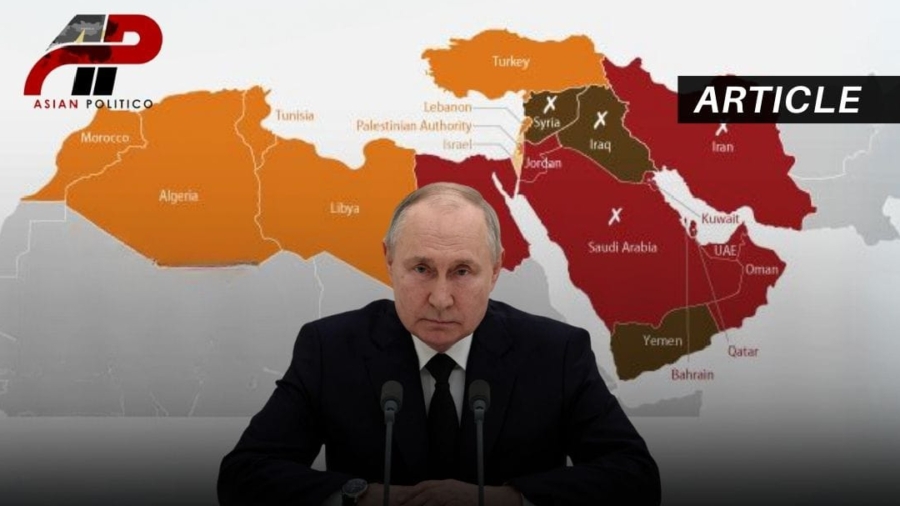
Conflict in the Middle East is at a level not seen for decades. The terrorist attacks on Israel on October 7, 2023, have marked more than a year of the spiral of escalation, one beginning to look increasingly like an aberration more than a new chapter in the region’s history. In the midst of increasing tensions in the Middle East and especially that involving Iran and Israel, the geo political map of influence was being redrawn. President Vladimir Putin’s Russia is increasingly becoming a key player filling the vacuum a perceived American weakness in the region. As Russian Foreign Ministry spokeswoman Maria Zakharova calls Biden administration’s efforts in region ‘a complete failure’. Commenting on Iran’s retaliation for the assassination of Hezbollah leader Hassan Nasrallah by Israel, she said on Telegram that the latest White House statements on the matter, “The complete failure of the Biden administration in the Middle East. A bloody drama that is only gaining momentum. The White House’s inarticulate statements demonstrate complete helplessness in resolving crises. The efforts of (US Secretary of State Antony) Blinken have led to tens of thousands of victims and a stalemate”. It is a sentiment that echoes the narrative working toward Russia as much a response to U.S. missteps as a stabilizing and de facto critical player. This article intends to have a probe into Russia`s intentions and strategies under Putin leadership in view of recent occurrences like the Iran-Israel state of affair and his gatherings with M.E different notable leaders.Historically, Russia has exercised little influence on the Middle East. The Soviet Union rhetoric against imperialism and the West appealed to a number of Arab governments who championed independence from colonial powers and embraced a state led economy: Libya, Egypt, Syria and Iraq. While its model ultimately failed to deliver on the expectations of Arab and Persian peoples in the late 1980s, the Soviet Union moderated its confrontational tendencies toward the West and United States in the last decade before disintegration of the Soviet Union.
After the collapse of the Soviet Union in the 1990s, Russia, under Boris Yeltsin, had gone into retreat from region. Russia was in the midst of domestic instability and economic hardships and lacked resources, and needed a place to think – to reevaluate foreign and domestic priorities. After the year 1999 when Vladimir Putin took charge, the tide changed. Putin restored political stability in Russia. High oil prices since 2014 gave his efforts a boost. Alliances with Egypt, Iraq, Syria and South Yemen were made in the 1960s and 70s during the Soviet influence in the Cold War, however, the balance of these dynamics has been completely different ever since the Cold War era. And the conflict in Yemen has left the country torn, while Iraq has been tortured by war and regime changes and Egypt has grown to be a key U.S. ally. Moscow has come to play a central role in the ongoing civil war in Syria, putting its renewed presence in the region on solid ground. There was no holding Russia back from the Middle East with its 2015 intervention in Syria. Following its backing of President Bashar al-Assad’s regime in the Syrian civil war, Moscow showed it was willing to flex its muscles to protect its interests. The intervention, moreover, not only saved Russia’s most important ally in the region but also enabled the Russians to present as a pivotal player in conflicts in the Middle East. Russia has also formed ties with Syria’s other regional powers, such as Iran and Turkey. Both economically and strategically, Moscow and Tehran are partners and both rely on the other to compete with the West, as it remains under its sanctions, and stand against U.S. dominance. Russia does not stop at the battlefield, as the west channels report that Russia sealed deals to build nuclear reactors as well as the matter of delivering FATH-360 missile to Russia to be used in Ukraine war and will be used in Iran’s civilian nuclear program. In addition to Turkey, a NATO member, Russia made inroads with Russia selling advanced air defense systems, such as the S-400. The move, however, was bound to complicate Turkey’s relations with the West, notably with the US, and underscore that Moscow could claim to have the leverage to determine the way geopolitics was shaped in the region. Russia has been quite successful here, placing itself at the center of a web of alliances between enemies and rivals that span the traditional divide in the Middle East.
Russia relies heavily on Iran since the war started in Ukraine. Iran has been supporting Moscow in the conflict and both have benefited working together particularly in Syria where they parallel aim to counter the US. Several Russian jets have threatened to ram US aircraft while pro-Iranian forces recently targeted the United States forces on the ground. Russia is accused of providing Iran with complex strike systems, and new-generation aircrafts, such as Su-35 multi-purpose fighter aircrafts, attack helicopters and modern radars. Some of these deliveries have been made such as the deliver of Yak 130 trainers and more deliveries may be made depending on the events in Ukraine. If the conflict in Ukraine move to the lower level Russia may increase supplies of military equipment to Iran which will create a threat to the U.S. And Israeli interest. Russia has also increased support for Iranian-supported militias, for example, Hezbollah. Prior arms supplies to organizations including the Hamas did not negatively affect Russia-Israel relations when arms supplies contributed to groups like Hamas, although the present escalation through Iranian proxies is likely to worsen the relations between Moscow and Tel Aviv. Then together with Iran‘s ballistic missile attack on October 1, speculation is growing that Israel would attack Iran’s nuclear, oil or military facilities, as it has been threatening to do, careful not to get Washington’s support for nuclear strikes. Ryabkov showed how the ever closer ties between Moscow and Tehran had already come complete with Russia repeatedly warning — and still warning — against even hypothetically contemplating the possibility of a strike on Iranian nuclear facilities or nuclear infrastructure. Russia has long opposed any such strike on Iran’s nuclear infrastructure, and that stance risks further entangling Moscow in the already embittered conflict between Iran and Israel. The relationship between Russian President Vladimir Putin and Iranian President Masoud Pezeshkian is strategic and it was apparent during their recent meeting.
Security cooperation and energy collaboration were the focus of discussion for the two countries both heavily sanctioned by the West. Iran’s policy of looking east to conflict Western pressure has led its partnership with Pakistan and long term agreements with China. That adds another layer of complication: Russia’s indirect involvement in Lebanon, through its backing of Hezbollah. Moscow has carefully tried to strike a balance between relations with Israel while maintaining support for Iran’s regional ambitions, and its limited reaction to Israeli air strikes on Hezbollah shows this. That’s something of a balancing act, the kind that Russia presides over in the region, but the growing alliances with Tehran may make neutrality untenable soon. The assertive attitude that Russia has taken towards the Middle East since around the early 2000s owes much to a blend of the strategic, economic and geopolitical. The collapse of the Soviet Union which lost Russia most of its influence in the region. But President Vladimir Putin has sought to restore Russia as a world power. A geopolitical catastrophe, he views the breakup of the Soviet Union as and has helped push Russia back through hard diplomacy and military intervention. To challenge Western influence is one of the key drivers of Russian policy. Moscow’s involvement in Syria’s civil war; its alliances with Iran and Turkey; and its role in Libya are all elements of a strategy to ratchet up the price of Western policy and stake out a central role on the periphery of regional conflicts. Russia saw the so-called ‘Arab Spring’ revolutions as a threat of their own – on a par with the ‘color revolutions’ rocking Eastern Europe – and actively waged a fight to shore up their interests.
Moreover, no discussion about Russia’s Middle East policy can ignore the important role that economic interests have to play in it. Russia sells weapons, grains and energy related products to a number of regional powers as well as seeking investment from oil-rich Gulf countries. It has further solidified ties with countries such as Saudi Arabia by cooperating in the energy sector, including OPEC. Russia’s civilian nuclear technology also points to its use of economic and strategic partnership to extend its influence with deals in Iran, Egypt and Turkey. Towards the end of it all, let us say that since he got in as president, President Vladimir Putin did much to resurface Russia as a major player in the Middle East territory, having made many strategic arguments, diplomatic moves, and economic coordinate interactions. As it helped decide key Syrian battles and hatched an alliance with Iran, Moscow has safely steered through the complicated web of regional wars and alliances. The result has been for Russia to assert itself, to challenge the West’s dominance in the region. Russia’s approach signifies a mix of history, pragmatism and strategic realism which shapes a country’s geopolitical agenda in the West. Russia has gained opportunities to consolidate its position as an inescapable actor in the Middle East where turbulent situations, power redistribution and ongoing renegade conflicts prevail. But this path is full of difficulties, from the thread line to walk on with enemies to the high probability of becoming further involved in the regional wars. With the Middle East at the center of the current geopolitical attention of the world, the views of the Russia on the ways forward are bound to cast a shadow on the future of the region. Whether Moscow can sustain its influence and navigate the complexities of Middle Eastern politics remains to be seen, but one thing is clear: Russia has returned to the forefront of power brokers in the reconfigured geopolitical theatre of the region.
References:RGR Chapter 9.pdf (marshallcenter.org)Russian Strategy in the Middle East | RANDhttps://carnegieendowment.org/russia-eurasia/politika/2024/08/russia-iran-vs-israel?lang=enhttps://www.aa.com.tr/en/world/russia-says-us-responsible-for-escalation-of-tensions-in-middle-east/3348536https://www.iranintl.com/en/202410177590file:///C:/Users/abc/Downloads/Russias_new_strategic_calculus_in_the_Mi.pdfhttps://www.aljazeera.com/news/2024/9/11/is-iran-supplying-ballistic-missiles-to-russia-for-the-ukraine-warhttps://www.armscontrol.org/act/2024-10/news/iran-said-ship-missiles-russiahttps://english.alarabiya.net/News/middle-east/2024/10/07/russia-s-putin-to-meet-iran-president-in-turkmenistan-on-friday-news-agencieshttps://www.aljazeera.com/news/2024/10/1/world-reacts-to-irans-missile-attacks-on-israel

Javeria Atiq, a graduate of International Relations from the National University.
Add a Comment