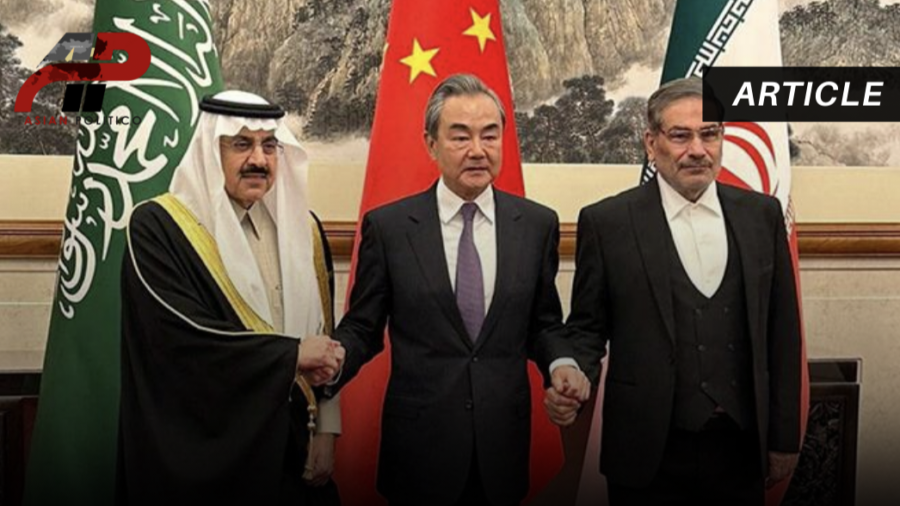
The rapprochement of March 2023 is a significant event that altered global dynamics dramatically. China brokered reconciliation between Iran and Saudi Arabia putting an end to the era of hostility. These two pillars of the Middle East have crippled Middle Eastern politics by engaging in proxy wars in Iraq, Yemen, Syria, and Lebanon. A sudden reconciliation has sparked debates about their historic enmity. During talks in Beijing, Iran and Saudi Arabia agreed to restore diplomatic relations strained since 2006 signing an agreement to respect sovereignty and non-interference in internal affairs. China emerged as a reliable and a good faith mediator. However, this generates various questions such as, why would China be interested in brokering relations between the two? How did America’s ally Saudi Arabia get along with America’s rival Iran?
China’s Diplomatic Breakthrough
China has played the role of mediator in normalizing relations between Iran and Saudi Arabia. China has always been a neutral country in Middle Eastern politics. China preferred to be out of all the proxy conflicts and avoided taking sides. Why has China now interfered in regional matters? The answer turns out to be very obvious. It is well known that China and the US are two global powers always in front of each other. Their conflict is like another cold war. They ally with each other’s foes to counter each other and balance their powers. Certain elements paved the way for China’s diplomatic win.
Saudi Arabia’s Disenchantment and Iran’s Well-Known Rivalry with the US
In the past few years, Saudi Arabia lost trust in the US. America has long backed Saudi Arabia against Iran. However, the recent attack on Saudi oil fields disclosed American hypocrisy as Donald Trump refused to interfere in the matter and favored Saudi Arabia. Since then Saudi Arabia fell into disillusion regarding the US. Hence, Saudi Arabia lost confidence in the US to promise the regional security. Resultantly, Saudi Arabia stepped forward to revive good relations with Iran.
Iran on the other hand has been at odds with America for decades. Iran is a traditional rival of the US. Since the 1979 revolution after Khamenei overthrew the pro-western rule of the Shah in Iran, the US and Iran became enemies. Moreover, the CIA-led coup in 1953 against elected Prime Minister Mossadegh left some elements of mistrust that prevented positive relations between Iran and US. Recently, Iran has been subject to international sanctions and freezing of funds by the US due to its nuclear program. In addition, Iran has been sheer supporter of the Houthi group in Yemen, Hezbollah in Lebanon, and Hamas in Palestine, which are entitled as terrorists in the Middle East by the US. Hence, ideological and geo-political differences have always been the drivers of rivalry between the US and Iran.
China’s Strategic Calculus
Keeping in view the conflicting relations of Iran and Saudi Arabia with the US, China seized opportunity to normalize relations between Saudi Arabia and Iran which would indirectly help China balance its power with the US. Moreover, Iran and Saudi Arabia are the biggest oil resources for China. Hence, China secured its future energy needs by brokering relations between both countries. China is also the initiator of the Belt and Road Initiative, and for China, to achieve its hidden goal of supremacy via BRI, is important to reconstruct the political situation in the Middle East. China has pursued a policy of economic supremacy rather than territorial supremacy. China aspires to spread its economic and subsequent political influence through BRI in the Middle East to become a global hegemon overpowering the US. This indicates why China has been so interested in mediating between Iran and Saudi Arabia.
Saudi Arabia’s Interest in Reconciliation with Iran
Saudi Arabia has been one of the good friends of the US for the past few years. Although both states have been rivals after 9/11, common interest brings the two enemies on common grounds. However, recent diplomatic situations have marked a turn in Saudi Arabia’s foreign policy. America has entangled itself in the Middle Eastern conflicts. Instead of mediating the conflicts, America has played a role in severing the political situation further in the region. Subsequently, Saudi Arabia lost its confidence in the US to ensure its security. Instead of acting as a mediator in Yemen, America exacerbated the situation by taking sides, thus furthering tensions between Saudi Arabia and Iran. Saudi Arabia has realized that security and peace in the region particularly with the neighboring countries is the condition for its Vision 2030. Saudi Arabia found an opportunity in China’s efforts to broker relations with Iran to align with its ambitious Vision 2030 plan. This socio-economic development strategy of Saudi Arabia promises to transform the kingdom and become a regional and global hub in cloud computing, logistics, trade, and industry. Keeping in view, Saudi Arabia stepped forward to end enmity with Iran otherwise, much-needed foreign investments for funding the projects would be endangered.
Saudi Iran detente is a turning point in global affairs, particularly in the Middle East, when Israel is trying to gain influence in the region. The US would face isolation in the region as both of its pillars of the Middle East have turned their backs on the US. China has become increasingly involved in the Middle East to gain its economic objectives that would help China counterbalance US in the Global power politics. Saudi Arabia is pursuing a policy of neutrality in the Middle East. This detente would bring peace and security back into the region as existed before 1979 and terminate the US monopoly in the region.

The Author, Arva Saeed is an undergraduate student of BSIR from International Islamic University, Islamabad and a research intern at the Asian Politico.
Add a Comment