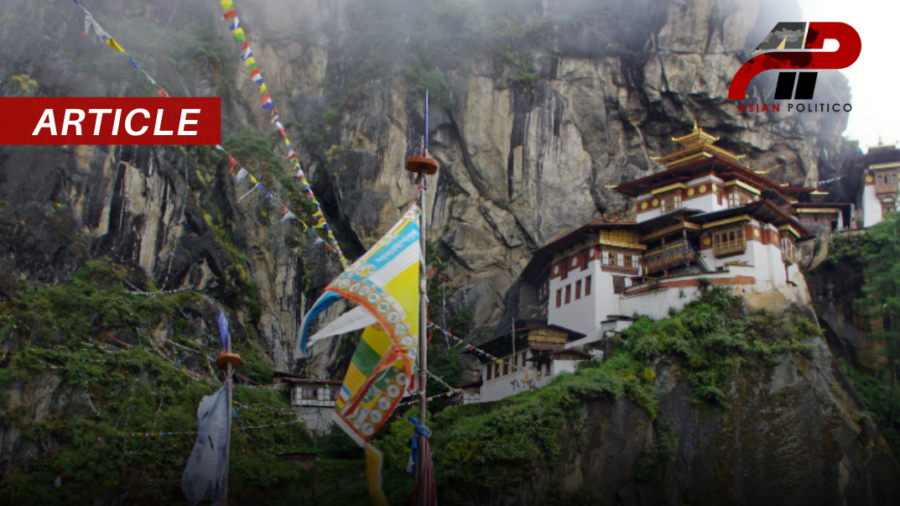
The world is gripped firmly by climate challenges. Carbon emissions, the prime contributor to climate degradation, need to be scrutinized. Every country across the globe is trying its best to reduce its carbon footprint, but the task seems strenuous owing to heavy dependency on fossil fuels and environmentally unsustainable practices. Among these countries, Bhutan rose as a leader in controlling its carbon emissions and becoming a carbon neutral country. In fact, Bhutan absorbs more carbon than its production, which led to the former Bhutanese Prime Minister Tshering Tobgay coining the term “carbon-negative” for the country. Bhutan has adopted strict and immediate measures to cater for environmental action and proved its resilience in the world, witnessing a gradual carbon surge.
If we observe the demography of Bhutan, it is located between China and India, which are top emitters of carbon dioxide. China has the highest emission level of 32.88%, while India ranks 3rd with 6.99% of total global carbon emissions. Despite being surrounded by immoderate emitters, Bhutan acts as a sinkhole to absorb excessive carbon released in the atmosphere.
The tilt of Bhutan towards environmentally sustainable practices is owing to their dependency on the economics of happiness. Political decisions are based upon the Gross National Happiness (GNH) Index, which ensures agendas relating to problems of common people be the apex of policy tables. Approximately 70% of the area of Bhutan is covered with trees that automatically absorb carbon from the atmosphere. It is applaudable that Bhutan’s commitment to the environment is reflected through their constitution. Article 5 of the Supreme Charter of Bhutan states that 60% of the of the area of Bhutan has to be covered with trees all the time by any means.
Bhutan has also taken measures to protect its abundant trees. Agarwood and Zachyl Burl, special species of trees considered the wealth of forest, are present in Bhutan. Acting swiftly, it has imposed a ban on log exports conserving the natural ecosystem. Bhutan has a series of interlinked rivers. It has used water flow to its advantage and generated free hydroelectric power that is more eco-friendly than resorting to fossil fuels. Bhutan has an excess of hydroelectricity that is exported to its neighbors, India. Bhutan has strategically added 9.53 million dollars to its treasury owing to the export of free energy. To cater for the needs of farmers and agriculture, Bhutan has provided free access to electricity to farmers. This action of Bhutan is farsighted, as 25% to 30% of overall carbon emissions are from the agricultural sector. Controlling both the power and agricultural sectors has enabled Bhutan to achieve the status of carbon-negative. There is no stopping Bhutan; despite an abundance of greenery, Bhutan has proved its commitment by planting 49,672 trees in a short time of one hour and making a world record.
Though Bhutan is a small country, it is achieving big feats. By 2030, Bhutan is planning to achieve the goal of zero greenhouse gas emissions and zero waste produced. To make this dream come true, Bhutan has to heavily rely on renewable energy resources. It has collaborated with Nissan to provide electric vehicles to people, with the aim to replace all vehicles depending on fossil fuels with subsidized electric vehicles. A huge portion of Bhutan’s economy is dependent on the tourism industry; it has created a record revenue of 26 million dollars in 2023. In recent years, increasing tourist footfall was a threat to the environment; as a result, Bhutan took a harsh step to restrict its visas to tourists. The interesting fact is that the revenue collected from tourists is termed the “Sustainable Development Fee (SDF), which is spent again to ensure a balanced eco-system and protected environment.
Bhutan’s pledge to its environment is remarkable. It sets examples for other countries to prioritize the environment over economic gains. There is always a critique of Bhutan, that its small area has helped it to achieve carbon-negative status, but that is not all. A small area added with the initiatives and efforts of the Bhutanese government has made it preserve the environment. The Bhutanese people also resonate with the government and support the green initiatives. Overall, Bhutan has achieved what no other nation has. It sets a road map for other countries to follow and achieve the unthinkable. Drops make an ocean, and small initiatives and sustainable practices will help curtail climate challenges for other countries as well.

The writer is a student of “Government and Public Policy” at National Defence University
Add a Comment