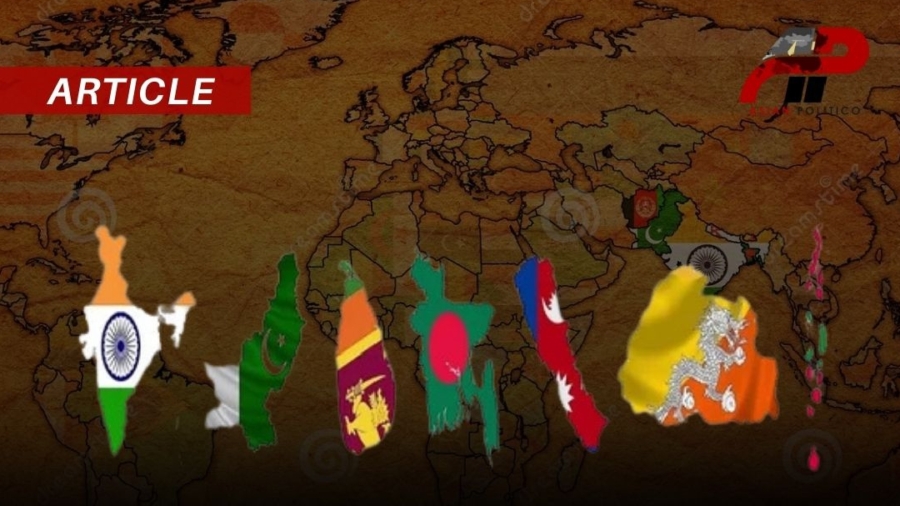
In the realm of regional cooperation, BIMSTEC and SAARC emerged as two major regional organizations in the South Asian region. Yet both organizations aim is to promote the welfare of their people, accelerate economic growth, and strengthen regional cooperation, social development, and cultural cooperation among the member states. However, a closer examinations show the distinct differences in their approaches, goals, and objectives. while SAARC has struggled with internal conflicts and inefficiencies, leaving a room for BIMSTEC to emerged as viable alternative. This article will discuss the relationship between BIMSTEC and SAARC and also address the key factors that have contribute to SAARC’s challenges in achieving its goals, and how does BIMSTEC offer a viable alternative.
Bay of Bengal Initiative for Multi-Sectoral Technical and Economic Cooperation (BIMSTEC) is an intra-regional cooperation established in 1997 with aim to promote economic cooperation among the nations bordering the Bay of Bengal. It consists of 7 South Asian and Southeast Asian countries including India, Bhutan, Bangladesh, Myanmar, Thailand, Nepal, and Sri Lanka. On the other hand, SAARC was established in 1985 with member countries comprising Afghanistan, Bangladesh, Bhutan, India, Maldives, Nepal, Pakistan, and Sri Lanka. Over several years BIMSTEC has gained much attention from the world as a promising alternative to SAARC, particularly because of its ability to provide different road for the regional countries. As SAARC is struggling with the tension between Pakistan and India over the Kashmir issue and BIMSTEC avoid those problems and focuses on practical things.
SAARC was established in 1985, and was unable to achieve its objectives in terms of regional cooperation and integration which led to its weak performance. SAARC’s failure has pushed countries to look for alternatives and led to the creation of BIMSTEC. Despite its establishment in 1985, SAARC has been unable to achieve much. Its performance is less than satisfactory as it has been plagued by the issue of noncooperation, limited progress, and issues to overcome bilateral disputes. Both renowned rivals, India and Pakistan are members of SAARC and both played their respective roles in hindering the SAARC’s progress.
BIMSTEC is home of 1.8 billion population and combined GDP of over 4.5 trillion. With its main focus on trade, energy and technology, BIMSTEC witnessed an impressive economic growth in intra-regional trade. The trade within BIMSTEC countries reached 90$ in 2019 shows its commitment to bringing economic benefits to its member states.
On the other hand, even after three decades of existence, SAARC has been unable to achieve its objectives because of some internal and external issues. Internally India’s dominance in SAARC as a regional hegemon has been influencing the organization to work in its interest which can be reflected clearly in the postponement of the SAARC 19 summit scheduled to be held in Islamabad Pakistan in 2016. Some of the member countries backed India’s call for boycott SAARC’s summit.
Moreover, the longstanding dispute between India and Pakistan over the Kashmir issue and the stubbornness of both countries to come on mutual grounds to solve their issue is hindering its regional integration efforts. As long as the issue of Kashmir remains alive between India and Pakistan, SAARC’s role in strengthening regional cooperation will be questioned. The primary objective of SAARC is based on regional cooperation and mutual trust but from the very beginning member countries treated it with suspicion and distrust. Leading to continues failure of organization. Furthermore, the organization’s inability to provide a platform for conflict resolution and lack of proper infrastructure and connectivity among member states further weakened its performance.
Likewise, BIMSTEC despite its potential for fostering regional cooperation faces numerous challenges and limitations. The significant challenges that BIMSTEC faces is growing influence of China in South Asian region and the differing levels of development among member countries which hinders the implementation of joint initiatives. For example, India and Thailand are more advanced countries, on the other hand, Nepal and Myanmar lag in terms of infrastructure and economic development. The difference in developmental level complicates the decision-making process and impedes the formulation of cohesive regional strategies.
There are strategic incentives for BIMSTEC countries countries to help the organization grow and succeed. For instance, Bangladesh sees BIMSTEC as a means to elevate its status beyond a small state, and Sri Lanka views it as an opportunity for the connectivity of Southeast Asia. Bhutan, and Nepal aims to overcome it landlocked geographic position by connecting with the bay of Bengal and India sees BIMSTEC as counterbalance for china’s influence. Southeast Asia has attracted significant attention from major global powers like China and the US due to its abundant natural resources, trade routes, and strategic choke points. For China, Southeast Asia is of utmost importance primarily, because China sees Southeast Asia as a major trading partner and source of investment, therefore China has been maintaining great economic, social, cultural, and infrastructural relations with Southeast Asian countries.
This growing influence of China in Southeast Asia has prompted India to take measures to maintain its influence in the region and to counterbalance China’s expanding influence, leading to the proposal of BIMSTEC. India sees BIMSTEC as a key vehicle to take forward India’s regional, strategic, and economic interests forward. As it perfectly aligns with India’s Foreign Policy objectives of “Neighbourhood First” and “Act East”.The organization’s significance was underscored when some member countries backed India’s call to boycott SAARC’s 19th summit which was supposed to be held in Islamabad in 2016. This resulted in the postponement of the summit and India claimed diplomatic victory.
BIMSTEC has become a bridge between SAARC and ASEAN and also provides an opportunity for India to continue to advance its regional interest in the absence of SAARC. India and China are both rapidly growing economic powers and are striving to widen up the sphere of their influence in the global economic market. So China’s influence in Southeast Asia, particularly in light of its road and belt initiative investment across BIMSTEC countries bothers India and India sees BIMSTEC as crucial in countering China’s assertiveness and growing influence in the region.
Over the years BIMSTEC has made notable improvements in areas such as energy cooperation, counter-terrorism, and disaster management, additionally, it has attracted the attention of major economies like Japan and the USA, which is evident from the growing participation of observer countries and dialogue partners in BIMSTEC meetings. However, it is important to understand that BIMSTEC does not seek to compete directly with SAARC, but rather provides a complementary platform for countries to address their challenges in the absence of a regional mechanism like SAARC.While it would be reductionist to view BIMSTEC solely in opposition to SAARC as both co-exist in the complex web of regional dynamics, each with its strengths and limitations. While SAARC continues to face internal challenges, BIMSTEC will provide opportunities for cooperation in specific areas and SAARC will remain a forum for border South Asian dialogue and cooperation.
In conclusion, the relationship between BIMSTEC and SAARC goes beyond mere competition or substitution. Despite its ambitious goals SAARC has been plagued by mistrust, political conflicts and ineffectiveness in resolving bilateral conflicts effectively. This has has left SAARC’s vision of unity unrealized. On the other hand BIMSTEC has made impressive progress by avoiding political issues. However, BIMSTEC’s own challenges, like differing levels of development among its member countries and limited institutional capacity, shows that BIMSTEC is not a perfect solution either. Rather than viewing these organizations in competition, it is important to recognize their unique role. BIMSTEC offers fresh opportunities for collaboration in specific areas that extends beyond traditional boundaries of South Asia, while SAARC remains a valuable platform for dialogue among South Asian nations. This reflects the delicate balance between pragmatism and idealism in regional cooperation.

The Author, Rida Muhammad is a dedicated International Relations student at International Islamic University Islamabad, aim to deepen her contribution positively to global affairs.
Add a Comment