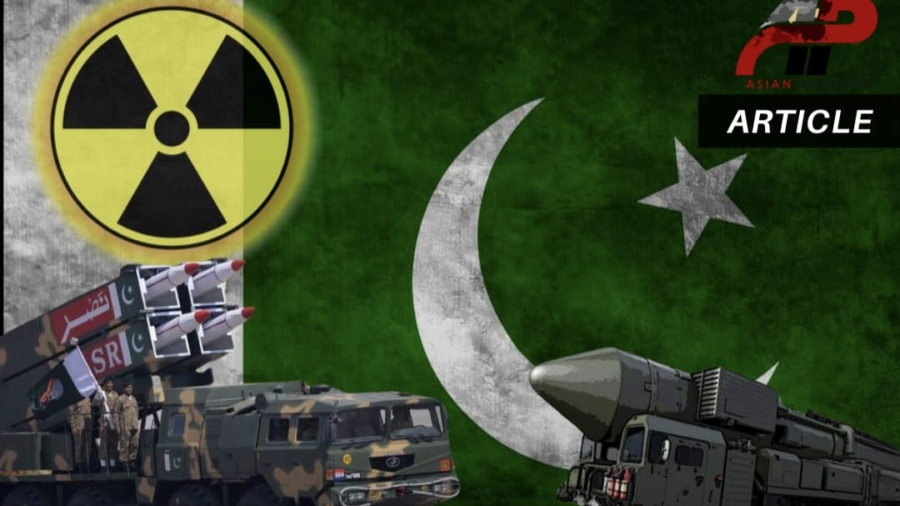
Pakistan has the nuclear capability for both peaceful and offensive purposes. Pakistan ranks 32 out of 47 countries in the nuclear security index for maintaining the SOPs of its peaceful facilities. As a nuclear weapon state, Pakistan has an unsaid nuclear policy that determines the circumstances when and how to use its nuclear assets. So, question arises, “What is Pakistan’s Nuclear Doctrine or is there even a nuclear doctrine?”.
Pakistan has never openly discussed its nuclear policy. So, the speculative analysis of limited data might help in determining the nuclear policy. Firstly, there is no public document that defines Pakistan’s nuclear policy. However, it is based on the statements of retired government officials during conferences and interviews in their personal capacity that Pakistan retains Credible Minimum Deterrence (CMD), leading to Full Spectrum Deterrence (FSD).
CMD refers to the maintenance of a minimum number of nuclear assets to deter the enemy from attacking. While FSD refers to the deterrence established via nuclear assets in every stage of conflict, from escalation to sub-conventional, conventional, or nuclear level.
The validation of Pakistan’s nuclear posture are the statements issued by the National Command Authority (NCA) and Inter-Services Public Relations (ISPR). The nuclear policy of Pakistan might be Indian-centric and “reactive” in nature rather than proactive. Pakistan decided to pursue the nuclear option after India tested its nuclear device in 1974. This indication illustrates the fact that Pakistan was in a security dilemma. Eventually, Pakistan openly tested its nuclear devices in 1998.
According to an opinion article by Ms. Sitara Noor, it is speculated that Pakistan keeps its nuclear weapons de-mated during peacetime, following the model of the Cold War. De-mated refers to the dismantled form of nuclear warheads from their launching mechanisms. But there is no official statement or substantial evidence available that can prove this speculation.
According to Ms. Sadia Tasleem, Pakistan may retain the option of First Use instead of No First Use policy. This speculation is based on the fact that Pakistan has introduced different types of nuclear warheads in its inventory in the past years; for instance, Ababeel was tested in October 2023. So, it might not be wrong to quote that if Pakistan has such weapons in its inventory, it might have the will and doctrine to possibly utilize them in war.
Force Structure
Pakistan became the world’s 6th nuclear-armed country by testing its first nuclear device in 1998. Although the precise yields of the country’s arsenal are unknown, estimates vary between 5 and 12 kilotons for most of the weaponry, while certain longer-range ballistic missiles can reach 40 kilotons.
In contemporary times, R&D is being conducted on three missiles: Shaheen-1A, Ababeel, and Shaheen-III. Moreover, there are rumors about underdeveloped ICBM but there is no substantial evidence available on it.
According to Center for Arms Control and Non-Proliferation, Pakistan has an approximate stockpile of 170 warheads.

Operational Policy
Pakistan Nuclear Command and Control is a balanced system based on military as well as civilian involvement. It is a three-tier structure with the National Command Authority (NCA), Strategic Plans Division (SPD) and armed forces strategic commands.
The NCA deals with the nuclear posture while overseeing the employment and development of all strategic nuclear forces and organizations. Formulating policies, deploying strategic forces, coordinating the operations of all strategic organizations, negotiating arms control and disarmament, supervising the implementation of export controls, and protecting nuclear assets and facilities are all associated with it.

Pakistan has also maintained ambiguity in terms of its targets. After the Balakot Airstrike, DG ISPR Major General Asif Ghafoor mentioned that after this press briefing, there is a meeting of NCA and you all know what the functions of NCA are. So, it is not sure that Pakistan will target the counter-force or counter-value targets because Balakot Airstike was entirely different level of engagement but DG ISPR responded with nuclear signaling.
But according to Mr. Naeem Salik in his dissertation titled “Pakistan’s Nuclear Force Structure in 2025,” the posture of FSD might engage with counter-force targets instead of counter-value targets.
Declaratory Policy
In October 1999, three former government officials—Foreign Minister Abdul Sattar, Foreign Secretary Agha Shahi and Air Chief Zulfiqar Ali Khan—jointly authored a newspaper article stating,
“Deterrence was the sole aim and a small arsenal was considered adequate. At no time did Pakistan anticipate use of nuclear weapons for warfighting or seek to develop capability for a pre-emptive attack.”
~Three former government officials, as stated above
The Ex-DG of Strategic Plans Division (SPD), Lt Gen Khalid Kidwai, defined the situations that would compel Pakistan to use nuclear weapons;
- India attacks and conquers a major portion of Pakistani territory.
- India destroys a large portion of Pakistani land or air forces.
- India proceeds with the economic strangling of Pakistan.
- India pushes Pakistan into political destabilization or creates a large-scale internal subversion in Pakistan.
Former Pakistani foreign minister Agha Shahi asserts that Pakistan’s nuclear strategy should be adaptable and dynamic to consider the evolving security conditions. Delivery by aircraft and land-based medium- and short-range missiles would be Pakistan’s minimal deterrence. The threshold of nuclear use will be inversely proportional to the level of balance or imbalance in conventional forces. Lt Gen. F.S. Lodi, supporting the nuclear first use policy while writing in his personal capacity, “We would use nuclear weapons if attacked by India, even if the attack is with conventional weapons.”.
Conclusion
Pakistan’s nuclear arsenal and signaling might be optimized towards national security, regional stability, and deterrence. The nuclear indications emphasize CMD to prevent the provocation of the arms race. However, Pakistan may retain the right of first use and second-strike capabilities as a reaction to the attack on the sovereignty of Pakistan in the form of SLCM, Babur-III.
The evolution of Pakistan’s nuclear arsenal is a consequence of regional dynamics. TNWs ensure the rigid deterrence of Pakistan to face off the challenge of conventional attack. Pakistan proves to be a responsible nuclear weapon state by ensuring the reliability and safety of its nuclear arsenal via its secured command and control system. This command and control system also surpasses the possibility of an accidental or unintentional nuclear launch.
In conclusion, Pakistan’s nuclear arsenal and signaling are vital pillars of national defense strategy, which smoothly sails through rough patches of regional instability, balance of power, assurance of national security, strategic stability, and aggression. The nuclear dynamics have been influenced by regional dynamics, the global security environment, and technological progress in the past and they will evolve in the future accordingly.

The author, Saad Burney, is a student of Strategic studies at the National Defence University, Islamabad, with an impeccable record of debating over international politics.
Add a Comment