Introduction:
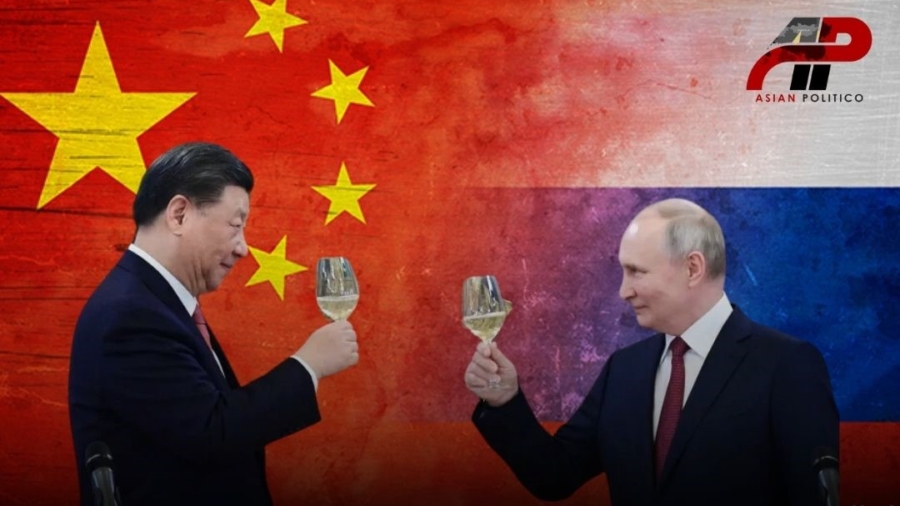
China and Russia, being neighbors witnessed periods of cooperation, competition, and conflict. Due to the shared views of both countries on contemporary world scenarios, they form a strategic alliance to create a multipolar world to balance the US hegemony. During the Cold War, the Chinese Communist Party established a bilateral treaty for security, economic, and military cooperation with the USSR. In 2001, they signed the Strategic Partnership Declaration, leading to the formation of the SCO and then gradually BRICS. Putin’s presidency further emphasized the strategic partnership by improving China-Russia relations and fostering political, economic, and military cooperation.
Due to widespread social acceptance of US liberal democratic norms, it became a global hegemon. Comparatively, China and Russia were trying to achieve a multipolar world order and started modernizing their economies and militaries. Around two decades ago, Russia was able to restore its loss of disintegration by becoming a part of a group of elite member countries in terms of economy (G8), and China boosted its economy and became the world’s 2nd largest economy after the US and may reach the top by 2030, according to a report by the World Bank. They aimed to reshape international institutions’ role and influence.
This article examines the Sino-Russian economic partnership, focusing on key drivers during the Xi-Putin era and its implications for the US.
Economic Cooperation:
Both leaders expressed their countries’ relations as a “No-limit partnership” before the verge of the Ukraine war. Beijing and Moscow are getting closer as a result of their dependency on each other because of world sanctions on Russia due to the invasion of Ukraine and China due to the claim of Taiwan over the One China Policy. According to Einar Tangen, a Beijing-based political analyst, one of the driving forces behind Sino-Russian ties is US sanctions. It can be said that Russia needs China more than China needs Russia in the current scenario, as Russia wants to integrate economically due to its increasing isolation from the West. Thus, it views China as a potential market for its exports and another source of investment. Meanwhile, China relies on cheap Russian oil to fulfill its project needs.
Several bilateral agreements between Xi and Putin have been made; Russia and China’s trade has significantly increased, with $ 140 billion in 2022. Since 2014, Russia has become China’s largest export destination, with China mainly supplying raw materials and importing manufacturing and technological products, which shows the economic interdependence between the two. Amid the Ukraine invasion, Russia switched from the West to China to purchase cars. The biggest win for China in trade with Russia is its vehicle manufacturers, which helped China take Japan`s place as the largest exporter of cars. China sold five times more cars in Russia in 2023 than in 2022. Domestic demand in China bounced back in 2023, with electric-vehicle sector growth.
Due to sanctions and European companies’ refusal to buy Russian raw materials, Russia sells raw materials at significant discounts to Chinese companies and will become the largest oil supplier to China in 2023. The Yamal LNG project and the Power of Siberia gas pipeline also supply liquefied gas to China. Russia’s major exports to China include oil, gas, steel, and coal. Both took the initiative to trade in their own currencies, the ruble and yuan, to reduce their reliance on the US dollar.
Implications for the US:
China and Russia, through their ties, are shielding their interests against the US by representing a significant geopolitical shift. They shared a common threat from the US-led West and are pushing for global realignment through non-Western institutions like BRICS and SCO, providing them an opportunity to enhance their capabilities and emerge as major powers parallel to the US. Due to sanctions imposed on Russia because of the Ukrainian invasion and the US-China trade war of 2018, both have been settling more contracts in Russian rubles and Chinese yuan, and this shift has been accelerating the de-dollarization trend.
The growing partnership between China and Russia faces a threat to the United States, particularly in key areas where Beijing and Moscow threaten the US’s national interests, making developing countries less dependent on her for their economic development through BRI and NDB. Deepening Sino-Russian defense relations could expand their power projection, accelerate their joint military efforts, and complicate US defense plans. Russia is a key ally in China’s efforts to undermine the US-set liberal order and, hence, is also a threat to its ideology.
Conclusion:
In a nutshell, in my view, America`s policy to hold its dominance and its expansion in Europe through NATO and involvement in Asian affairs leads to the strategic partnership between Beijing and Moscow, which has the potential to reshape international order. Thus, any proactive actions by these three powers to enforce change may threaten global peace and stability.

The Author, Mahpara Gull is an independent researcher holding a Bachelor's degree in IR with a focus on Foreign Policy and Diplomacy.
Add a Comment