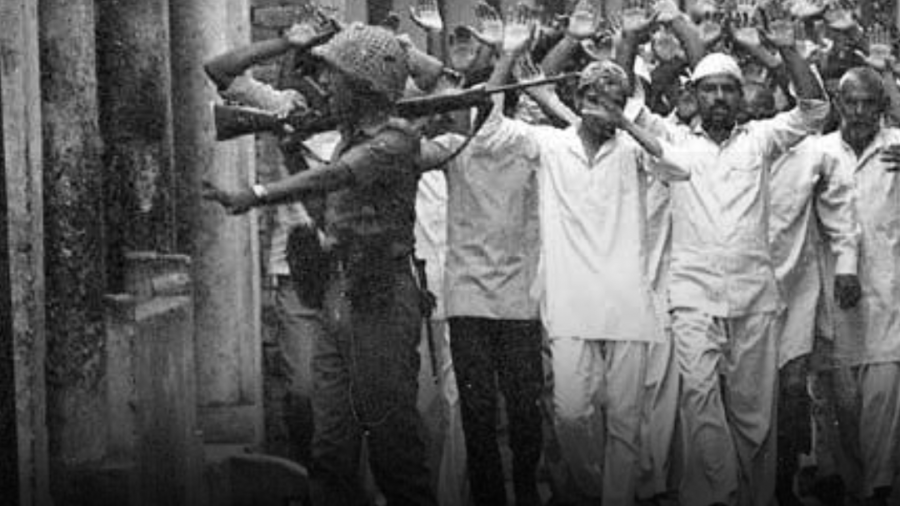
The horrifying events of the Hashimpura Massacre in May 1987 shook the nation. This was a dark chapter in history that demands justice.
The Hashimpura Massacre took place on May 22, 1987, in Meerut, Uttar Pradesh, India. It involved the targeted killing of over 42 Muslim men by personnel from the Provincial Armed Constabulary (PAC). On a Friday during the month of Ramadan, Hashimpura residents were just hours away from breaking their fast when 600–700 men were forcibly removed from their houses by members of the army, CRPF, and PAC.
The PAC chose men to take the brunt of their gunfire, loaded them into their vans, and headed for a canal on the edge of the Ghaziabad district, where they began their a massacre. The victims were ordered to jump out of the truck but As soon as the first person jumped, gunshots filled the air, Those inside the truck started screaming, but indiscriminate firing continued. Struggling to get the others to jump out, the PAC soldiers started firing inside the truck, while shouting at their colleagues to catch the ‘circumcised’ by the collar and throw them out. Bodies were being thrown in the canal. Everyone struggled to drag themselves further into the truck while being pushed from behind.
They removed the surviving and carried out the same act they had started at the Murad Nagar canal in Makanpur village, Ghaziabad. After the shootout, the killers made all efforts to ensure that nobody was alive; they searched for life among the dead through the ravines using a torch. Whenever they saw even a slight movement, they would shoot. They kicked the bodies lying outside the canal to ensure that nobody was alive. The soldiers then hopped into the truck and drove away. Miraculously, despite the PAC’s best efforts, there were four survivors from the first execution and two from the second, who were shot and thrown into the canal survived, and would later recount the horrific tale as prosecution witness. Out of the deceased, only 16 bodies were recovered which was not shown to the family of the victims.
According to Vibhuti Narain Rai’s book Hashimpura: 22 May, following the massacre, there was a suggestion made at a meeting that was attended by Vir Bahadur Singh, the chief minister of Uttar Pradesh at the time, as well as other politicians and senior bureaucrats, to kill the six survivors in addition to eliminating all witnesses to the horrifying events. Better sense prevailed. But the fact that such a suggestion was even uttered in such a responsible company shows that the rot ran deep.
Rai draws attention to the majoritarian bias of state institutions, highlighting the dominance of right-wing members in the political leadership, local police, and PAC. The stereotype of the “savage” Muslim that the people of Meerut district advocated served as cover for the institutions’ bigotry.
The survivors of the massacre narrated harrowing tales of the events that unfolded that fateful night. Their accounts shed light on the systematic targeting and execution of innocent civilians solely based on their religious identity. A victim describes what he had to face in the jail: “One of my brothers was killed in the police line; he had been beaten very badly. Police officers urinated in the mouth of the Muslims. Their beards were plucked. There was barely a single man left without bloodied or broken legs, hands or heads. We were attacked by prisoners, which left five dead.”
The aftermath of the massacre was marked by outrage and protests demanding justice for the victims. However, the road to justice has been long and arduous. Amongst those who survived, Badruddin and Zulfiqar lodged an FIR. The case witnessed multiple twists and turns, with several hurdles in the legal process.
A survivor, Zulfiqar faced the first press conference on 1June,1987 at the Janta Party. Office where he recounted the horror of Hashimpura in the presence of senior politicians like Chandra Shekhar and Subramanian Swamy. Most newspapers didn’t give much weight to the story and pushed it to the inside pages.
Before the massacre
May 22 didn’t materialise out of thin air. Rai recounts meetings “of all top civil and police officers” on May 21-22 which also saw active involvement of “army officials”– who were posted in Meerut due to the precarious law and order situation at the time amid continuous communal conflagrations. The would-be killers and those tasked with selecting the victims were chosen at these meetings.
Botched investigation meant that these meetings were never seriously probed and the masterminds of the massacre were never tried for their crimes.
In May 1996, chargesheet was filed against 19 personnel of the 41st battalion of the PAC, the footsoldiers who pulled the trigger and not those who ordered them to do so. The accused were not arrested despite 23 non-bailable arrest warrants being issued against them b/w 1997 and 2000 and were in active service throughout this period but the gov. pleaded in court that they were “absconding.”
Several CID reports note Major Kaushik’s presence in Hashimpura when Muslims were being selected for their impending slaughter, however, he was never called for investigation. Rai asserts that senior police officer B.K. Chaturvedi would have been a key witness to the meetings. He was called for polygraph tests, but he never appeared. He never faced consequences for his absence. Major B.S. Pathania, who was the armed forces’ column commander at the time, also failed to appear despite being repeatedly called by the investigating authorities. He didn’t face any consequences either.
In 2015, after nearly three decades, a Delhi court acquitted all the accused personnel due to lack of evidence. This decision left the victims’ families devastated and raised questions about the efficacy of the justice system in addressing communal violence.
Despite the acquittal, the fight for justice continues. Later when the verdict was challenged by the victims families, in October 2018, the Delhi HC sentenced them to life imprisonment. The survivors and activists have tirelessly campaigned for a re-trial, seeking accountability and closure. Their perseverance serves as a reminder that the truth cannot be buried, and justice must prevail.
The Hashimpura massacre was meant as a collective punishment to the Muslims for the death of a high-ranking official’s family member. There was no real intent to find the culprit who shot Prabhat Kumar, instead a decision was taken by the higher-ups to select the healthiest Muslim men, akin to choosing the strongest cattle at a fair, and murder them.
The Hashimpura Massacre serves as a grim reminder of the communal tensions that have plagued our society at various times. Hashimpura was not a case of police firing during riots, but a case the bloodiest ever custodial killings in India, merciless and barbaric use of brute state force against 42 innocent Muslim men on ground of their religious affiliation so as to send out a clear message to the .’cruel’ community.
Over the years, the Hashimpura Massacre has gained attention in national and international media. It stands as a stark reminder that truth and justice cannot be silenced, and the world must know about the atrocities committed against innocent lives.

Bringing you updates across Asia!
Add a Comment